

4 X 4 12 Answer
| Why do we need it? | How to use brackets | The basic rules | The consummate rules | Using calculators | Quick quiz |
Why exercise we need an order of operations?
Example: In a room at that place are ii teacher'due south chairs and 3 tables each with iv chairs for the students. How many chairs are in the room?
We know there are 14, only how do we write this calculation? If we just write
2 + 3 x 4
how does a reader know whether the answer is
two + 3 = five, then multiply past 4 to get 20 or
3 x 4 = 12, then 2 + 12 to become 14?
In that location are ii steps needed to discover the answer; add-on and multiplication. Without an agreed upon club of when we perform each of these operations to calculate a written expression, nosotros could get ii dissimilar answers. If we want to all get the same "correct" reply when we only accept the written expression to guide the states, it is of import that we all interpret the expression the same way.
One way of explaining the club is to apply brackets. This always works. To say that the 3 ten iv is done before the adding, we would use brackets like this:
two + (3 x 4)
The brackets show us that 3 x 4 needs to be worked out outset and then added to 2. Withal, we tin also agree on an order of operations, which is explained below.
Another example: Summate 15- 10 ÷ v
If y'all do the subtraction first, you lot volition get 1. If yous do the division get-go, which is actually correct according to the rules explained below, y'all will become 13. We need an agreed order.
| division first (right) | subtraction showtime | blue indicates the operations existence worked on first |
| fifteen - x ÷ 5 | 15 - x ÷ 5 | |
| = 15 - x ÷ 5 | = fifteen - 10 ÷ v | |
| = fifteen - 2 = 13 | = 5 ÷ five = 1 |

How to utilize brackets
Brackets are marks of inclusion which tell us which parts of an expression go together. We employ brackets in an expression to indicate which part to calculate showtime. It can be useful to think of brackets equally a circumvolve with the acme and lesser deleted to remind you that brackets indicate that everything inside the 'circumvolve' is self-contained and must be worked out starting time. Although brackets usually await like ( ), brackets tin as well look like { } or [ ] and need to be treated in the same way. Brackets are sometimes referred to as "parentheses".
| want partition first | want subtraction first | bluish indicates the operations being worked on outset |
| 15 - (10 ÷ v) | (15 - x) ÷ 5 | |
| = 15 - (10 ÷ 5 ) | = (fifteen - 10) ÷ five | |
| = fifteen - two = 13 | = five ÷ v = one |
At that place are more examples on how to employ brackets in complicated examples below.
If we used brackets consistently we would not have to be concerned with the order of operations. Nosotros could but work from innermost brackets outwards to somewhen become our answer. However using lots of brackets tin get tedious and disruptive, as in the following case, and then we demand some agreed rules.
3 + ((4÷2)x7)-(half-dozen÷3)-((4x2)+((eight÷two)+(3x3)))
You can check how to piece of work out this monster by clicking here, simply the next section tells you lot how to avoid the worst monsters.
YOU Tin can ALWAYS USE BRACKETS TO Show HOW
A CALCULATION SHOULD Exist Washed
The basic rules
Many years agone mathematicians decided on an 'order of operations' that anybody should employ when performing mathematical computations from written instructions. This ways that when presented by the same problem everyone using this agreed convention of order of operations would obtain the same answer. Y'all could recollect of the order of operations as a sort of 'maths grammar' which enables mathematicians to communicate with each other and with machines all over the world.
It is important to realise that the order of operations has nix to do with underlying mathematical principles: it is just convention. Other rules could have been invented. Withal the convention needs to be understood earlier it can exist successfully applied to every problem.
The four rules below are enough for most purposes:
| • | RULE one: Calculate anything in brackets first, then utilize the other rules. (For further discussion about expressions with more than than one set of brackets, encounter the adjacent section.) |
| • | Rule ii: If a calculation involves merely addition and subtraction, piece of work from left to right. |
| • | Rule 3: If a calculation involves only multiplication and division, work from left to right. |
| • | Dominion 4: Practice multiplication and sectionalization before improver and subtraction. |
Example of Rule 2: 10 - 3 + 2
This involves only addition and subtraction, so nosotros work from left to right. 10 - 3 + 2 is equal to nine because we calculate 10 - three first, then add together 2. Nosotros do Not practise 3+two first, then subtract from 10.
Case of Rule three: 48 ÷ 2 ten three
This involves only multiplication and partitioning, so nosotros work from left to right. 48÷ 2 ten three is equal to 72, because 48 ÷ 2 = 24 and 24 x three = 72. We practice NOT work out ii ten iii = 6 and then do 48 ÷ vi = 8.
Example of Dominion 4: 4 + five ten iii
Multiplication has precedence over addition. four + 5 ten iii is equal to 19 considering v 10 3 = 15 and 4 + 15 is 19. Nosotros do Non work out 4 + 5 first to get 9 and then multiply by 3.
Example of Rule 1: (4 + five) x 3
(iv + 5) x iii is equal to 27, because nosotros calculate the brackets kickoff to 4 + 5 = 9 and then multiply by 3. Nosotros practise NOT work out 5 x 3 and and so add 4.
Examples using all of the rules together:
Example: 72 + four x 6 ÷ 2 - viii
| Working out | Thinking text | ||||||||||||||||||||||||||||||||||||||||||||||||||||||||
| |||||||||||||||||||||||||||||||||||||||||||||||||||||||||
Example: 15 - 12 ÷ (vi ÷ 2) x 4
| Working out | Thinking text | |||||||||||||||||||||||||||||||||
| ||||||||||||||||||||||||||||||||||
The complete rules
BODMAS, BOMDAS, BEMDAS, BIDMAS etc..
Many of us were taught to use the BODMAS or BOMDAS mnemonics or other variations to determine the order of operations. They summarise the rules above:
brackets kickoff,
then multiplication or partition (left to right)
then addition or subtraction(left to correct).
| Brackets | Either BODMAS or BOMDAS must be interpreted equally implying the same order of operations. | |
| and then | Of | |
| or | Multiplication | |
| or | Division | |
| then | Addition | |
| or | Subtraction |
However blind adherence to these mnemonics (retentivity aides) without agreement of the mathematical ideas they represent will lead to misunderstandings and wrong usage, particularly when they are practical to more complicated expressions.
B O D Chiliad A S - the "B"
"B" comes showtime, so in evaluating an expression, do the brackets first. We have talked about how and why brackets are used in the section above, How to use brackets. But what if there are several brackets?
Dominion for multiple brackets: If at that place are brackets in the expression, calculate them first. If in that location is more than ane set of brackets then begin with the innermost brackets and piece of work outwards. If at that place is more than than ane gear up of brackets but they are isolated from each other, and so exercise them independently.
Example: Expressions with multiple brackets.
iii ten ((2+(3x4)) + (v(eight÷4) - 9))
| Working Out | Thinking |
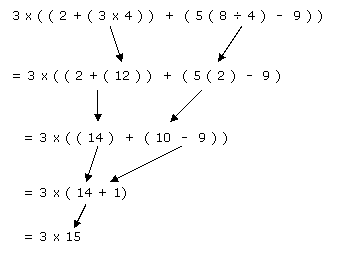 | Nosotros piece of work on the innermost brackets first. Here there are two isolated sets of inner brackets. So we movement to the side by side level of brackets and so on. |
B O G D A S - the "O"
The 'O' in BODMAS stands for 'of', which is a verbal indication of multiplication. It is really included as a convenient vowel for the mnemonic to work every bit a word.
Did y'all know that in other versions of the retentivity adjutant, such every bit BIDMAS and BEDMAS, the 'O' has been replaced by 'I' for indicies or 'E' for exponents respectively. This is useful as it extends the mnemonic to expressions which involve squares etc. See beneath.
B O 1000 D A South or B O D G A South - the "M" and the "D"
Mutual misconception 1: BOMDAS tells me to do multiplication before division.
Common misconception 2: BODMAS tells me to do division before multiplication.
Actual rule: Multiplication and segmentation are changed operations and as such need to be treated equally. When confronted with multiplication and division, ever work from left to correct.
Case: 105 ÷ iii ten v
105 ÷ 3 x 5 is equal to 175 considering we work out 105 ÷ three = 35 first and then multiply by 5. We do NOT work out three x 5 = fifteen first and and so divide 105 past 15. This would give us an incorrect reply of 7. BOMDAS and BODMAS give the aforementioned answer, correctly interpreted.
B O M D A S or BODMAs - the "A" and the "S"
Mutual misconception 3: BOMDAS or BODMAS tells me to do addition before subtraction.
Common misconception 4: It doesn't matter what order you exercise addition or subtraction.
Bodily dominion: Addition and subtraction are inverse operations and as such demand to be treated equally. When confronted with addition and subtraction, always work from left to correct.
Instance: 3 + 7 - 4 - 9
3 + 7 - 4 - 9 is equal to - iii because we piece of work out the add-on first, 3 + 7 = x, and 10 - iv = vi, then 6 - ix = - three.
We can run across that if we did Non piece of work from left to right and worked out four - 9 = - v beginning, and and then subtracted this from 3 + 7 then,
iii + vii - (- 5) = 10 + 5 = fifteen
B I D M A South OR B E D M A Due south - the "I" or "E"
Powers, fractions and roots
Powers (as well known as exponents or indicies), fractions and roots are not covered by BODMAS or BOMDAS merely nosotros yet need to know how to handle them. Fractions, powers, roots and other self contained parts of expressions should be treated equally if they are in brackets, i.due east. piece of work them out showtime.
Example: 4 + 2 iii 10 6
We care for 2 3 as if it is in brackets and work this out first. 2 3 is equal to 8. Then we go on with, 4 + eight x 6 which is equal to 52 considering we practise the multiplication first and then the addition.
Case: (2 + 3) 2
In this expression the brackets around the addition of ii + 3 indicate that information technology is ii + three that is raised to the power of two, NOT merely three. Nosotros must work out the brackets start and so square the answer. v ii = 10
Example:
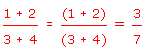
Actual dominion: Fractions should be treated as if the numerator is in brackets and the denominator is in brackets and the fraction bar (the "vinculum") is sectionalization.
Example:

Nosotros work out the square root start to get 3 and then do the division and multiplication working from left to right. 12 ÷ 3 x ii is equal to 8. We cannot do anything with  until it has been simplified. Also, you will notice once again that if nosotros do the multiplication before the segmentation and then nosotros will get a dissimilar answer.
What to remember:
Piece of work on one level at a time, starting at the top and going downward.
Within each level, work from left to correct.
| Brackets | |||
| powers, roots and fractions | |||
| multiplication and segmentation | |||
| addition and subtraction |
Activities
Four fours
Using four fours and any mathematical operations and signs you wish, can you make every number from 1 to 20. Can yous make every number up to 100?
For example, (4 +4) x iv - 4 = 28 and 4 + (4 x 4) - 4 = 16.
This is an first-class activity for a form to do over a week. Brand a large chart with a infinite for one or more than expressions for each number. Students can enter their expressions on the class chart after they take been checked. The instructor tin can decide what signs are allowed.
Manipulating expressions
half-dozen + 17 - 15 x iv ÷ three
By inserting brackets into this expression (every bit many as you lot like, wherever yous like) make expressions with every bit many answers equally you tin can.
The right answer when there are no brackets is
6 + 17 - 15 10 four ÷ iii = 3.
This set up of inserted brackets changes the reply to 8.66:
6 + (17 - 15) 10 4 ÷ 3 = half-dozen + 2 x 4 ÷ 3 = 6 + 8 ÷ 3 = 6 + 2.66 = 8.66
Using calculators
Not all calculators accept correct order of operations built in. More sophisticated calculators have programmed logic which enables them to use the standard mathematical conventions. Others just process the information/keystrokes exactly equally they are entered.
Example: If you lot need to calculate 1 + 5 x seven and enter these 6 key presses:
| 1 | + | five | ten | vii | = |
some calculators give 42 (1 + 5 gives vi, multiply past 7 gives 42) and others give 36 (multiply first so 5 10 vii = 35, add together 1 + 35 giving 36).
The 2nd is the correct answer for the expression.
Find out how your computer works and check to meet if information technology has brackets to help be precise. Learn how to employ the memory to go along intermediate answers.
Quick quiz
| i. | Using the case 10 - 1 - two , show why you need to follow the correct club of operations. |
| 2. | Calculate the following expressions: |
| (a) | 11 10 (three + 2) x 4 ÷ 2 |
| (b) | 7 - 18 ÷ two x 3 + v |
| (c) | 42 ÷ 3 x vii |
| 3 . | Calculate nine + 4 ÷ 2 ten 7 - vi ÷ 3 - iv x 2 + 8 ÷ 2 + 3 x three |
| 4. | Using the expression in question three, make 3 alternative expressions and answers past inserting brackets. |
| 5. | Find the answer to, showing the method you lot have used to ensure y'all follow the right guild of operations, east.thou. checklist, color scheme, arrows etc. |
| 6. | Calculate the following expressions: |
| (a) | 32 ÷ iv2 x (3 - viii) |
| (b) | 81 ÷ (four - 7)3 |
| (c) |  |
| (d) |  |
| (e) |  |
| 7. | Find out how to use your calculator to evaluate the expressions in question 6. |
| 8. | Bernie is in the process of landscaping the gardens of 2 new townhouses. If he buys 30 bundles of 12 wooden planks for the fence for each business firm and 15 bundles of ten hardwood planks for the decking for each house, write an expression for the total number of planks bought and then piece of work it out. If Bernie then returned ii bundles of the wooden fence planks but bought 5 actress bundles of the hardwood planks, write a new expression and then work out the answer. |
| 9. | Two thirds of all Twelvemonth 8 students, one quarter of all Twelvemonth 9 students, merely xxx Year 10 students and two fifths of Year 11 and 12 students combined ride their bike to school. If there are 99 Twelvemonth viii students, 124 Year 9 students, 111 Year 10 students, 65 Year xi students and fifty Twelvemonth 12 students attending the school, how many students ride their wheel to school. |
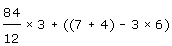
| 10. | (300 ÷ (x x 2)) x iv. Create an appropriate worded problem from this mathematical expression. |
To view the quiz answers, click hither.
Monster multiple brackets example!
| 3 + ((4÷2)x7) - (six÷iii) - ((4x2) + ((8÷2) + (3x3))) | ||
| = | 3 + ((iv÷2)x7) - (6÷three) - ((4x2) + ((8÷2) + (3x3))) | |
| = | 3 + ((2)x7)) - (2) - ((8) + ((4) + (9)) | |
| = | 3 + (14) - (2) - (eight + (xiii)) | |
| = | 3 + (14) - (2) - (21) | |
| = | 3 + 14 - 2 - 21 | |
| = | 17 - two - 21 | |
| = | 15 - 21 | |
| = | -half dozen | |

4 X 4 12 Answer,
Source: https://extranet.education.unimelb.edu.au/SME/TNMY/Arithmetic/wholenumbers/operations/orderofops.htm
Posted by: bagleylidantollas.blogspot.com
0 Response to "4 X 4 12 Answer"
Post a Comment