

A Diameter Is Also A
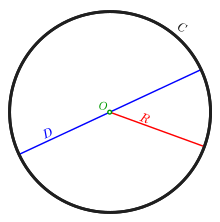
Circle with
diameter D
radius R
center or origin O
In geometry, a diameter of a circle is whatsoever straight line segment that passes through the center of the circle and whose endpoints lie on the circle. It tin can likewise be defined every bit the longest chord of the circle. Both definitions are too valid for the bore of a sphere.
In more modern usage, the length of a diameter is as well called the bore. In this sense one speaks of the diameter rather than a diameter (which refers to the line segment itself), because all diameters of a circle or sphere accept the same length, this being twice the radius



For a convex shape in the airplane, the diameter is divers to exist the largest distance that can be formed between two opposite parallel lines tangent to its boundary, and the width is often defined to be the smallest such distance. Both quantities can be calculated efficiently using rotating calipers.[1] For a curve of abiding width such as the Reuleaux triangle, the width and diameter are the aforementioned because all such pairs of parallel tangent lines have the aforementioned distance.
For an ellipse, the standard terminology is dissimilar. A diameter of an ellipse is whatsoever chord passing through the center of the ellipse.[2] For example, conjugate diameters have the holding that a tangent line to the ellipse at the endpoint of one bore is parallel to the conjugate diameter. The longest diameter is called the major axis.
The word "diameter" is derived from Ancient Greek: διάμετρος ( diametros ), "diameter of a circle", from διά ( dia ), "across, through" and μέτρον ( metron ), "measure".[3] It is oft abbreviated or


Generalizations [edit]
The definitions given to a higher place are only valid for circles, spheres and convex shapes. Notwithstanding, they are special cases of a more full general definition that is valid for any kind of -dimensional (convex or non-convex) object, such equally a hypercube or a gear up of scattered points. The bore or metric diameter of a subset of a metric space is the least upper spring of the set up of all distances between pairs of points in the subset. Explicitly, if is the subset and if is the metric, the diameter is


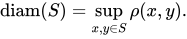
If the metric is viewed hither as having codomain (the set of all existent numbers), this implies that the diameter of the empty fix (the case ) equals (negative infinity). Some authors prefer to treat the empty set as a special case, assigning information technology a diameter of [4] which corresponds to taking the codomain of to be the ready of nonnegative reals.


For any solid object or fix of scattered points in -dimensional Euclidean space, the diameter of the object or set is the same as the diameter of its convex hull. In medical parlance concerning a lesion or in geology apropos a rock, the diameter of an object is the to the lowest degree upper bound of the set of all distances betwixt pairs of points in the object.
In differential geometry, the diameter is an important global Riemannian invariant.
In planar geometry, a diameter of a conic section is typically defined as any chord which passes through the conic's centre; such diameters are not necessarily of compatible length, except in the case of the circle, which has eccentricity

Symbol [edit]

Sign ⌀ in a technical drawing
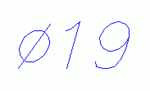
Sign U+2205 ∅ EMPTY Gear up from an AutoCAD drawing in dim.shx font with an angle 16°. This font does not comprise U+2300 ⌀ DIAMETER SIGN.
The symbol or variable for diameter, ⌀, is sometimes used in technical drawings or specifications as a prefix or suffix for a number (e.grand. "⌀ 55 mm"), indicating that it represents diameter. For example, photographic filter thread sizes are oft denoted in this style.
In German, the diameter symbol (German Durchmesserzeichen) is also used every bit an average symbol (Durchschnittszeichen).
Similar symbols [edit]
The Latin small-scale letter o with stroke ø is similar in size and design to this. The diameter symbol ⌀ is distinct from the empty set symbol ∅, from an (italic) uppercase phi Φ , and from the Nordic vowel Ø (Latin majuscule letter O with stroke).[5] Come across as well slashed nil.
Encodings [edit]
The symbol has a Unicode code point at U+2300 ⌀ Bore SIGN, in the Miscellaneous Technical set. On an Apple Macintosh, the diameter symbol can be entered via the character palette (this is opened by pressing ⌥ Opt ⌘ Cmd T in nearly applications), where it can be found in the Technical Symbols category. In Unix/Linux/ChromeOS systems, information technology is generated using Ctrl+⇧ Shift+U2 three 0 0 space. It can be obtained in Unix-like operating systems using a Etch key by pressing, in sequence, Compose d i.[6] In Windows, it can be entered in near programs with Alt lawmaking 8960.
The character will sometimes non display correctly, however, since many fonts exercise non include information technology. In many situations, the Nordic letter ø at Unicode U+00F8 ø LATIN Small Letter O WITH STROKE (ø) is an acceptable substitute. It can be entered on a Macintosh by pressing ⌥ Opt O (the alphabetic character o, not the number 0). In Unix/Linux/ChromeOS systems, information technology is generated using Ctrl+⇧ Shift+UF viii space or Compose o /. AutoCAD uses U+2205 ∅ EMPTY Set available every bit a shortcut string %%c.
In Microsoft Word, the bore symbol tin can be caused past typing 2 3 0 0 and then pressing Alt+X.
In LaTeX, the diameter symbol can be obtained with the command \diameter from the "wasysym" package.[7]
See also [edit]
- Angular diameter – How big a sphere or circle appears
- Caliper, micrometer, tools for measuring diameters
- Conjugate diameters – Perpendicular diameters of a circle or hyperbolic-orthogonal diameters of a hyperbola
- Diameter (grouping theory), a concept in group theory
- Eratosthenes, who calculated the diameter of the World effectually 240 BC.
- Graph or network diameter – Length of shortest path betwixt two nodes of a graph
- Hydraulic diameter
- Inside bore
- Jung's theorem, an inequality relating the diameter to the radius of the smallest enclosing ball
- Semidiameter – Term in geometry; half of a shape'south diameter
- Sauter mean bore
- Tangent lines to circles – Line which touches a circle at exactly one signal
- The diameters of a screwthread
- Ø (disambiguation)
References [edit]
- ^ Toussaint, Godfried T. (1983). "Solving geometric problems with the rotating calipers". Proc. MELECON '83, Athens. CiteSeerX10.1.1.155.5671.
- ^ Bogomolny, Alexander. "Conjugate Diameters in Ellipse". www.cut-the-knot.org.
- ^ "diameter - Origin and meaning of diameter by Online Etymology Lexicon". www.etymonline.com.
- ^ "Re: bore of an empty set". at.yorku.ca.
- ^ Korpela, Jukka 1000. (2006), Unicode Explained, O'Reilly Media, Inc., pp. 23–24, ISBN978-0-596-10121-3 .
- ^ Monniaux, David. "UTF-viii (Unicode) compose sequence". Retrieved 2018-07-13 .
- ^ "wasysym – LaTeX back up for the wasy fonts". Comprehensive TeX Annal Network . Retrieved 2022-03-11 .

Expect upward bore in Wiktionary, the gratuitous dictionary.

A Diameter Is Also A,
Source: https://en.wikipedia.org/wiki/Diameter
Posted by: bagleylidantollas.blogspot.com
0 Response to "A Diameter Is Also A"
Post a Comment